Copper conducts. Aluminum is light. Double-sided copper-aluminum clad material exists because an increasing number of current-carrying parts need both properties inside the same piece of metal, and plating or bolting two metals together rarely delivers a durable answer.
At Goode, our copper-aluminum composite line serves battery manufacturers, charging equipment builders, and power electronics producers who are working to cut mass and cost without giving up electrical performance. This guide explains what the material actually is, how it is produced, where it is used, and which details deserve attention before you write it into a specification.
Content
Double-sided copper-aluminum clad material is a three-layer composite: a lightweight aluminum core sandwiched between two thin copper skins. The layers are metallurgically bonded across the full interface rather than glued, plated, or mechanically fastened, so the finished strip behaves as a single metal when it is cut, bent, punched, or welded.
The copper skins carry current and provide a surface that solders and welds reliably while resisting oxidation. The aluminum core lowers density and material cost. Because copper appears on both outer faces, the sheet is symmetrical: the same joining process works on either side, forming tools do not favor one face, and the part can be oriented freely during assembly.
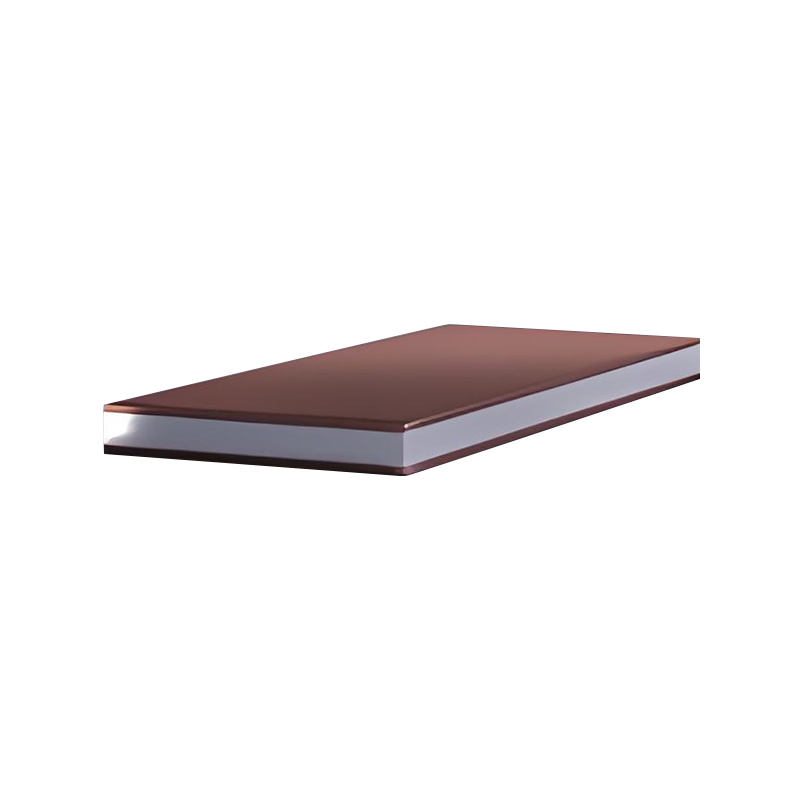 Double-sided Copper-Aluminum Clad MaterialOur Double-sided Copper-Aluminum Clad material is an innovative power transmission product designed for efficiency and lightweight performance. This busbar utilizes ad...View Product →
Single-sided clad material places copper on one face only. That is efficient when conductivity is required in a single direction, but it introduces asymmetry. Copper and aluminum expand at different rates, so a single-sided strip tends to bow when it heats up, and every downstream welding or brazing step has to be planned around which face is exposed.
Double-sided construction cancels most of that imbalance. The two copper skins respond to temperature almost equally, which keeps flatness stable through thermal cycling and makes automated feeding and welding far more predictable. There is a maintenance argument as well. In a battery pack or a switchgear cabinet, parts get handled, cleaned, and reworked; with copper on both faces, a scratch or a reworked joint does not expose bare aluminum to moisture and galvanic corrosion.
Exact figures depend on the copper-to-aluminum ratio, which is set project by project. The table below shows the indicative ranges engineers usually start from when comparing the composite against solid copper and solid aluminum at comparable thickness.
| Property | Pure Copper | Pure Aluminum | Double-sided Cu-Al Clad |
|---|---|---|---|
| Density (g/cm3) | about 8.9 | about 2.7 | about 3.6 to 5.0 |
| Electrical conductivity (% IACS) | about 100 | about 61 | about 65 to 90 |
| Weight relative to copper | baseline | about 30 percent | about 40 to 60 percent |
| Relative material cost | high | low | moderate |
| Solderability of the outer faces | excellent | difficult | excellent on both faces |
Because the numbers shift with layer ratio, the specifications that matter most are the ones you state explicitly in the drawing. In practice, buyers should confirm the following before releasing a purchase order:
Composite strip is produced by roll bonding. Two copper strips and one aluminum core are degreased, wire-brushed, stacked, and passed through a rolling mill under high pressure. The thickness reduction fractures the surface oxide films and presses fresh, active metal into contact, creating a solid-state bond without any filler metal or adhesive layer.
A controlled annealing step develops that bond and restores ductility to the work-hardened layers, and finish rolling brings the strip to final gauge. Slitting and edge trimming follow, with the finished coil inspected before packing.
Quality control concentrates on the interface, because that is where failures originate. Ultrasonic scanning detects unbonded areas or delamination; peel tests quantify bond strength on samples taken from each coil; conductivity checks confirm that the copper skins and the transition zone meet the agreed values. Dimensional inspection covers thickness, width, camber, and flatness, since even a small waviness can jam an automated stamping line.
In electric vehicle battery packs, mass reduction is measured in grams per part and multiplied across hundreds of connections. Double-sided clad strip is used for battery negative terminals, cell-to-busbar links, and internal conductors where aluminum on the exterior would corrode or weld poorly. The copper faces accept ultrasonic welding to nickel-plated terminals and laser welding to copper busbars, while the aluminum core keeps the assembly light.
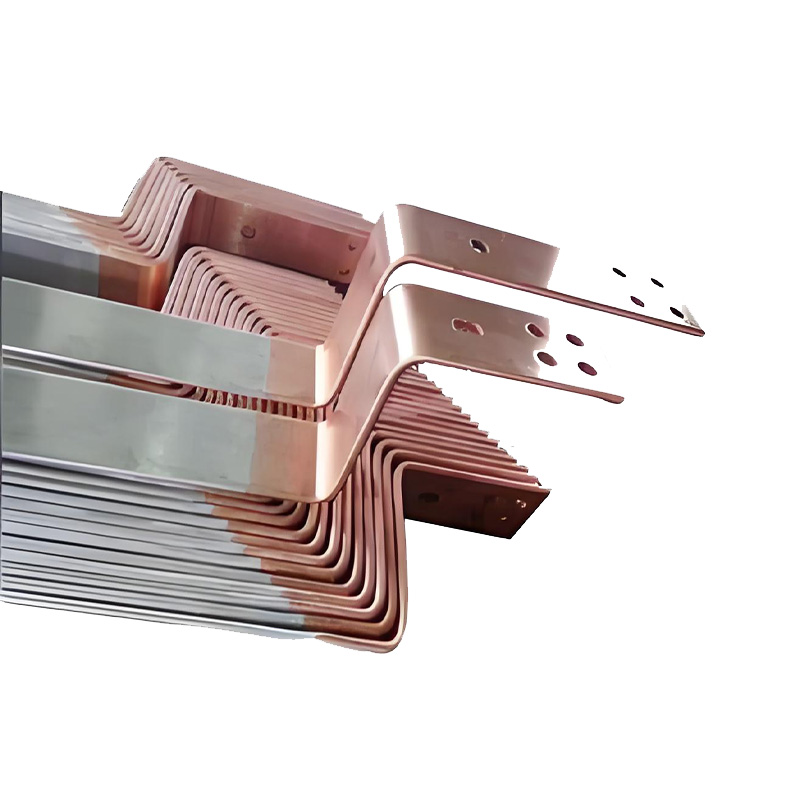 BusbarThis high-performance busbar is precisely manufactured from high-purity copper, offering excellent electrical conductivity and mechanical strength. Through optimized s...View Product →
Combined charging units and on-board power modules combine high current with tight packaging. Clad material lets designers keep copper exactly where the joint and the contact resistance demand it, and aluminum everywhere else. A related benefit shows up in thermal management: the same structure spreads heat effectively, which is why it appears in radiator base plates and other components where electrical connection and heat dissipation happen in one part.
Outside the automotive world, double-sided clad sheet is used for electromagnetic shielding enclosures, heat spreaders, and PCB substrate layers where a solderable copper surface on both sides simplifies assembly. The aluminum core reduces weight in handheld and airborne equipment, and the bonded interface avoids the galvanic corrosion that appears when copper and aluminum are simply bolted together in a humid environment.
Most design problems with clad material are not material problems at all; they are process problems that were not planned for early enough. The following sequence keeps projects on schedule:
One more design option worth knowing: where a single part has to connect copper on one end and aluminum on the other, a transition plate does the job in one component and removes an extra joint from the assembly.
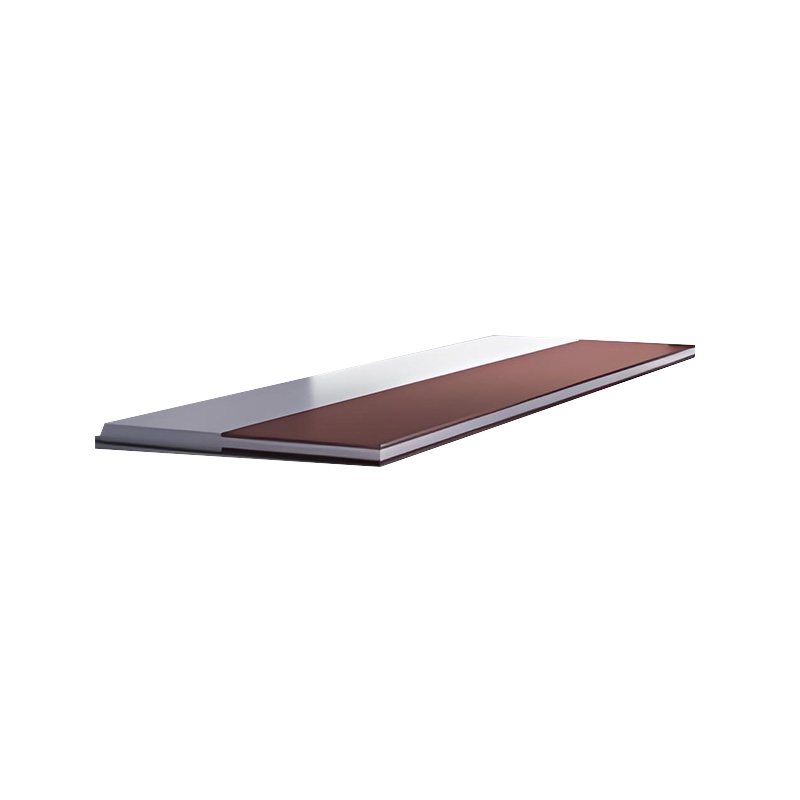 Double-Sided Copper-Aluminum Clad Transition PlateOur Double-Sided Copper-Aluminum Clad Transition Plate is a high-performance metal material specifically designed for applications requiring lightweight and superior t...View Product →
Goode EIS (Suzhou) Corp LTD is an advanced functional materials company focused on insulation composites and lightweight conductive components for new energy vehicles, clean power generation, and transmission and distribution equipment. Our automotive business unit covers thermal runaway protection, lightweight solutions, and copper-aluminum composites, while our electrical business unit supplies insulation resins and structural parts for generation, distribution, and medical imaging equipment.
Under our copper-aluminum composite material line, we produce single-sided and double-sided clad strip, transition plates, and precision copper-aluminum foil, supported by multiple manufacturing sites and a supply chain managed against recognized sustainability and responsible-sourcing programs.
Double-sided copper-aluminum clad material is not a compromise between copper and aluminum; it is a deliberate engineering choice that places each metal where it performs best. Specify the copper ratio against your real current and thermal requirements, agree on interface testing before production starts, and plan your joining processes around the composite rather than around solid copper.
If you are evaluating clad material for a battery, charging, or power electronics program, our team is glad to review your drawing and recommend a layer configuration that fits both the electrical target and the mass budget.

 Applet
Call Center:
 Tel:+86-0512-63263955
 Email :[email protected]
Copyright © Goode EIS (Suzhou) Corp LTD
 Insulating Composite Materials and Parts for Clean Energy Industry


 cn
cn English