Anyone who has opened up a failed battery pack will tell you the same thing: the damage rarely starts where the fire broke out. Heat finds the weakest interface first. That is why EV battery thermal pads — those thin, easily overlooked layers between cells, modules, cooling plates and enclosures — carry a surprising share of the responsibility for how a pack behaves during fast charging, on a 40 °C afternoon, or in the minutes after one cell tips into thermal runaway.
At Goode, we have spent years supplying insulation and protective materials into battery and power-electronics programs, and the questions we get from pack engineers are almost always practical ones. How thick should the pad be? Does a higher conductivity number actually help? What happens after 500 compression cycles? This article is a plain-language walkthrough of what these pads do, which material systems exist, and how to choose one without over-engineering the problem or missing something obvious.
Content
The word "thermal" leads people to assume a single function, but in practice these components are asked to do two opposite jobs at once. Some are designed to move heat out of a cell and into a cooling plate as efficiently as possible. Others are designed to slow heat down, keeping a failing cell from dragging its neighbours along with it.
Conductive pads act as a thermal interface material. Even two apparently flat surfaces only touch at a handful of microscopic high points, and the air trapped in between is a poor conductor. A compliant pad fills those voids, replacing air with a medium that transfers heat far better, and it does so while absorbing tolerance stack-up between the cell and the cold plate.
Insulating pads work the other way around. They sit between adjacent cells, under module covers, or along the housing, and their job is to combine low thermal transmission with high dielectric strength and flame resistance. Many of them also provide mechanical cushioning during swelling and vibration, and act as a physical barrier if a cell vents.
In most packs, both functions appear side by side, which is why material selection is rarely a single-variable decision. A pad is simultaneously a thermal component, an electrical insulation component, a mechanical component, and a fire-safety component.
The material systems used in EV battery thermal pads have converged around a handful of families. They differ less in "performance" as an abstract number and more in which failure mode they are built to prevent.
| Material system | Heat path | Typical position | What to watch |
|---|---|---|---|
| Ceramic-filled silicone gap pad | Conductive | Cell base to liquid cooling plate | Compression set, bleed, thickness tolerance |
| PU foam + aerogel + PET film (GA100) | Insulating | Cell side walls, module wrap | Compression limits, film integrity |
| Nano-silica frame + PET film (GA200) | Insulating | Cell spacing and flame barrier | Frame parallelism, dimensional stability |
| Silicone frame + aerogel (GA310) | Insulating | Between cells, module walls | Edge sealing, dust control |
| Mica + fiberglass (GM02) | Insulating, high temperature | Cell barriers, top cover | Brittle edges, added mass |
| Rigid mica insulation pad | Insulating | Prismatic cell faces | Moisture uptake, flatness |
| Dispensable gap filler | Conductive | Irregular pack-level gaps | Cure time, rework difficulty |
Silicone-based gap pads remain the default choice for the cell-to-cold-plate interface because they compress predictably and survive thousands of small movements. Their weaknesses are equally well documented: silicone oils can migrate, and a pad that is over-compressed at one corner and under-compressed at another will not deliver the thermal performance printed on its datasheet.
Aerogel systems take the opposite approach. By combining a very low-conductivity aerogel layer with a structural carrier, they block heat rather than move it. In the Thermex cell-protection range, GA100 pairs PU foam with aerogel and a PET film, which makes it a workable barrier for cell side walls where weight matters and where the pad must not crumble when handled during module assembly.
GA310 takes a slightly different route, using a silicone frame around an aerogel core. The frame gives the part a defined outline and repeatable thickness, so automated pick-and-place equipment can handle it without crushing the aerogel, while the core keeps the thermal conductivity low and the temperature resistance high.
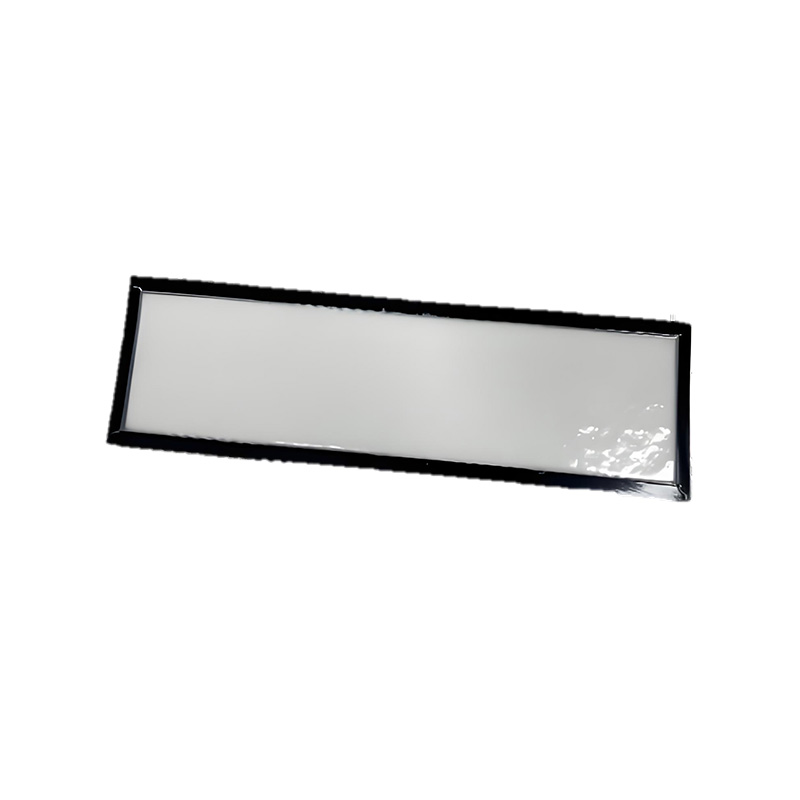 GA310 Silicone-Framed Aerogel Battery Thermal PadA silicone-framed aerogel pad for automotive battery cells, offering low thermal conductivity, flame resistance, cushioning and repeated handling support.View Product →
Mica composites occupy a different niche again. Where a barrier needs to survive direct flame impingement and hold its shape at high temperature, mica combined with fiberglass offers a level of thermal and electrical robustness that foams cannot match. The trade-off is weight, stiffness and a certain brittleness at cut edges that has to be managed in design.
It helps to think of thermal pads in three layers, because the requirements change at each one.
The closest to the electrochemical action. Here pads wrap prismatic or pouch cell faces, separate neighbouring cans, and provide a first barrier if one cell vents. At this level, dimensional tolerance matters more than raw conductivity, because a pad that is 0.2 mm too thick will stop the module from closing properly. Rigid mica pads and mica-fiberglass composites such as GM02 are common here, since they hold their shape under clamping force and remain dimensionally stable through thermal cycling.
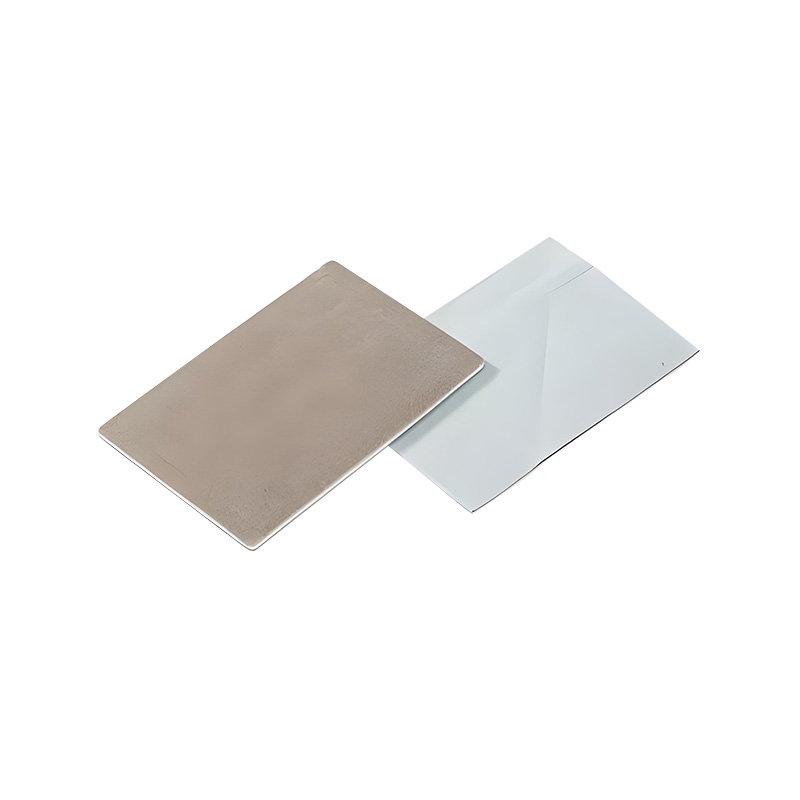 GM02 Mica-Fiberglass Battery Thermal PadA mica-fiberglass composite pad for cell-level thermal insulation and electrical isolation, chosen for dimensional stability under clamping and flame resistance.View Product →
Module-level pads control the direction heat travels once a cell has failed. End plates, module covers and release plates are less about steady-state cooling and more about steering vented gas and flame away from healthy cells. Materials are usually chosen for a combination of flame resistance, low thermal transmission and structural support.
Pack-level components sit between the module and the outside world. Top covers need fireproofing and thermal insulation, the housing floor and sidewalls need protection against external impact and internal heat, and the BMS, busbars and electrical connectors need dielectric protection that survives vibration. This is also where dispensable gap fillers appear, filling the awkward uneven gaps that no die-cut pad can reach.
Datasheets give you a starting point, not an answer. The selection criteria that actually decide whether a pad works in a pack tend to look like this:
We covered this ground in more detail in our article on selection criteria for EV battery thermal pads, which is worth a read before you freeze a specification.
Most pad failures we encounter are not material failures. They are interface failures that started on a drawing.
None of these are exotic. They come up because pack design teams are under time pressure and the pad is usually one of the last items to be locked down.
Our Thermex line was built around exactly these layers — cell, module and pack — so that pack engineers can source a matched set of barriers rather than assembling one from unrelated suppliers. Behind the products sits an insulation materials background that stretches from resin systems for generators and transformers to mica composites and copper-aluminium laminates, which means most of the core material science happens in-house.
We also know that a specification is only useful if it can be manufactured. Production is organised across our Suzhou base and additional sites in Binzhou, Luhe and Mexico, and our responsible-mica and responsible-minerals commitments are part of how we answer supply chain questions from customers who are audited on exactly that. If you want the broader picture, our Thermex thermal runaway protection solutions page shows how the cell, module and pack products fit together.
Practically speaking, the fastest way to narrow down a candidate is to send us the cell format, the available gap, the compression you can tolerate and the test standard you are working to. From there a shortlist of two or three material systems is usually obvious, and samples follow quickly.
EV battery thermal pads will never be the most exciting part of a pack design, and that is rather the point. They are meant to sit quietly, absorb tolerances, block the heat they should block, and pass the heat they should pass, for fifteen years without anyone thinking about them again. Get the material system right, validate it at the level it will actually operate, and the rest of the pack has one fewer thing to worry about.

 Applet
Call Center:
 Tel:+86-0512-63263955
 Email :[email protected]
Copyright © Goode EIS (Suzhou) Corp LTD
 Insulating Composite Materials and Parts for Clean Energy Industry


 cn
 English