Copper is the material engineers trust to carry current. Aluminium is the material they reach for when weight and cost start to matter. Bond the two into a single sheet — properly, metallurgically, not with adhesive — and you get a part that conducts like copper while shedding a large share of the mass. That is the straightforward promise behind Cu-Al composite materials, and it explains why they turn up in places as different as an electric vehicle busbar and a high-voltage switchgear assembly.
We are Goode, an advanced functional materials company based in Suzhou, and copper-aluminium composites sit alongside our insulation systems and thermal-runaway protection lines. In the pages below we walk through what these materials actually are, how they are made, where they genuinely earn their place, and which details decide whether a Cu-Al part performs for fifteen years or gives trouble in the field.
Content
A Cu-Al composite is a single workpiece in which copper and aluminium are bonded across an interface, usually with a thin intermetallic transition zone that grows during bonding and annealing. It is not glue and it is not a press fit. A good bond survives rolling, punching, bending and the thermal cycling of a real application without delaminating.
Two families dominate the market. Layered composites — clad sheet, strip and foil — place a copper skin on one or both faces of an aluminium core, or join copper and aluminium edge to edge in a transition joint. Mixed-phase composites disperse copper particles through an aluminium matrix, a route seen mostly in research and niche structural parts. Commercially, the layered family does the heavy lifting, and it is what most engineers mean when they say Cu-Al composite.
The appeal is arithmetic. Copper is roughly 3.3 times denser than aluminium, so replacing part of the copper volume with aluminium removes weight quickly. Aluminium conducts at about 61% IACS against copper's 100%, so a clad structure keeps resistance low in the copper-rich regions while the aluminium core carries mechanical load and spreads heat. Add a steadier raw-material cost profile and you have a material whose case survives a budget review.
Almost everything that determines performance is decided at the interface. Whichever process is used, the goal is the same: remove surface oxide, bring clean metal into intimate contact, and give the joint enough heat and pressure to diffuse without growing an unnecessarily thick brittle phase.
Two cleaned strips are brushed, stacked and rolled under heavy reduction. The severe deformation fractures surface oxides and exposes fresh metal, and a subsequent diffusion anneal grows the bond across the interface. Further rolling thins the sandwich to final gauge, including precision foil. Because it is continuous and repeatable, roll bonding suits volume work in automotive and electrical components, and it gives the tightest control over layer thickness ratio.
A detonation drives a flyer plate into the base plate at an angle, jetting away oxides and leaving a wavy, mechanically interlocked interface. Explosive welding handles thick plate and large areas that rolling cannot reach, which makes it popular for heavy transition joints in power equipment. It is less suited to thin strip and to parts that need very uniform layer ratios.
Co-extrusion pushes a copper-clad aluminium billet through a die to form rod and profiles. Continuous casting produces clad strip directly from the melt. Powder metallurgy and electrodeposition cover special geometries and very thin coatings. Each route trades interface quality, thickness range and cost at volume differently, so the process should follow the part, not the other way round.
The numbers below are orientation values, useful for early-stage design conversations rather than for a drawing tolerance block.
| Property (typical) | Copper | Aluminium | Cu-Al composite |
|---|---|---|---|
| Density (g/cm³) | 8.96 | 2.70 | Between the two, set by copper ratio |
| Electrical conductivity (% IACS) | 100 | About 61 | 60 to 100, depending on layer ratio |
| Thermal conductivity (W/m·K) | About 398 | About 237 | Tuned between the two |
| Thermal expansion (ppm/K) | About 17 | About 23 | Weighted by layer thickness |
| Raw-material cost trend | High, volatile | Lower, steadier | Below solid copper |
Two mechanical points deserve attention early. First, bond strength is usually verified by shear and peel testing plus a bend test, because a joint that looks sound can still be weak. Second, the copper-aluminium interface is where thermal fatigue concentrates, so cycling data matters more than a single room-temperature reading.
Most projects start from one of five standard forms, and the choice usually follows the joining method at the assembly line rather than the drawing alone:
You can review the full range of Cu-Al composite materials we produce to see how layer ratios and tempers are configured for each form.
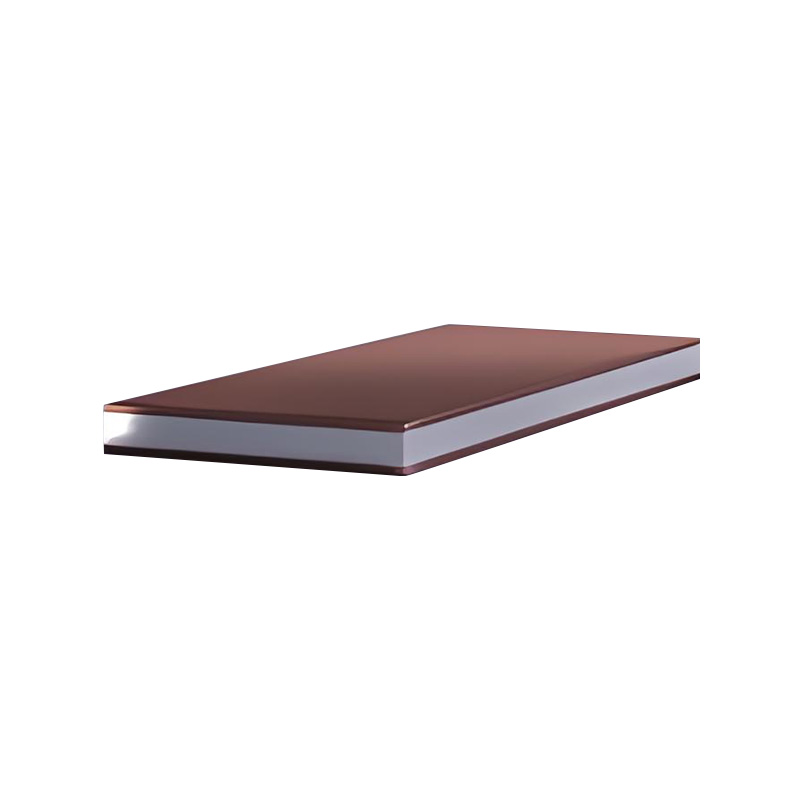 Double-Sided Copper-Aluminum Clad Material for Power TransmissionCopper-aluminum composite with a copper face and lightweight aluminum face, suited to high-voltage power systems and weight-sensitive installations.View Product →
Many cell designs present an aluminium terminal, while the pack-side connection is copper. Welding those two directly invites a galvanic couple and a brittle joint. A Cu-Al transition part moves the dissimilar-metal interface into a controlled, factory-bonded component, so the assembly line welds aluminium to aluminium and copper to copper. The result is a lower-resistance joint, a simpler weld schedule, and one less corrosion site inside the pack.
 Battery Negative Terminal for High-Performance Battery SystemsHigh-purity copper terminal with precision machining and welding compatibility, worth reviewing for battery connectors needing conductivity and stable assembly.View Product →
A solid copper busbar is heavy, and in a vehicle every kilogram costs range. A clad busbar with an aluminium core and copper skins keeps current-carrying surfaces copper where contact resistance matters, while the core removes mass from the middle of the section. The same logic applies in distribution equipment, where transition plates let aluminium cable lugs meet copper busbars without a bimetallic washer stack.
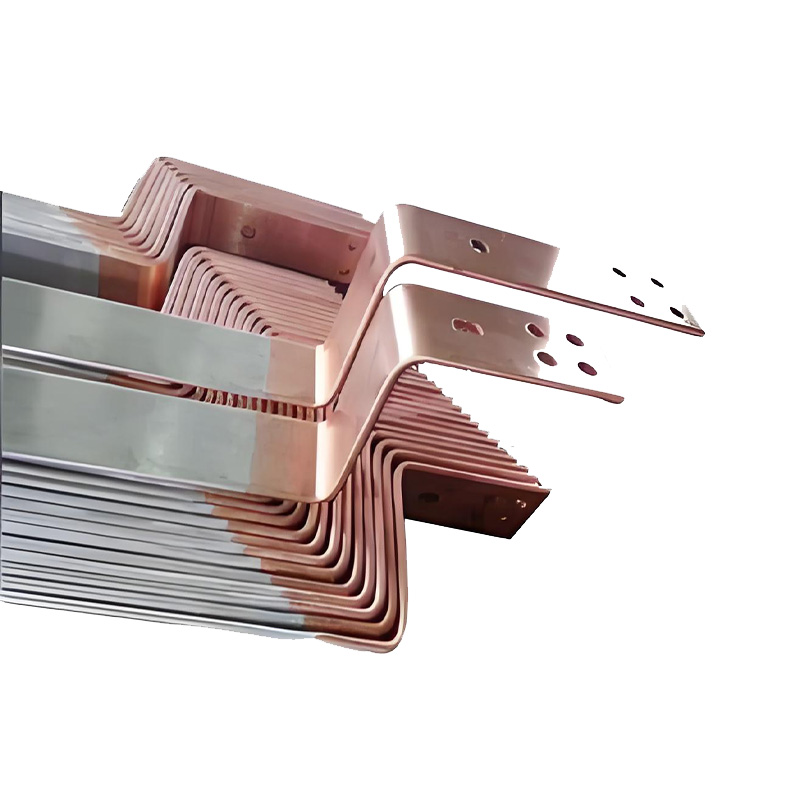 Custom Copper Busbar for Automotive Batteries and Power DistributionHigh-purity copper busbar with customizable dimensions and hole positions, offering lightweight structure and reliable current transmission for battery applications.View Product →
Because the composite spreads heat as well as current, it fits radiator base plates, heat-sink interfaces and liquid-cooling structures where a copper contact face is wanted but a solid copper body would be wasteful. Combined charging systems use the same trick: copper at the contact points, aluminium through the body of the conductor.
This is the objection every Cu-Al project meets, and it deserves a direct answer. Copper and aluminium sit far apart on the galvanic series, so in the presence of an electrolyte the aluminium becomes the anode and corrodes preferentially. Inside a well-made composite, the bond interface is protected and the reaction is slow. The risk concentrates at exposed cut edges, at fastener contacts, and anywhere chlorides can pool.
Bonding always produces some intermetallic phase — typically several micrometres thick in a well-controlled process. That layer is hard and brittle. Keep it thin through controlled annealing, avoid excessive service temperature, and the joint stays strong. Let it grow during a poorly controlled thermal excursion and the interface becomes the weakest link in the part.
Practical countermeasures are well established: nickel or tin plating on exposed copper, sealed or coated cut edges, plated fasteners, insulating barriers between the composite and a dissimilar metal, and drainage design that stops water sitting on an aluminium face. Specify the coating and the edge treatment on the drawing, not in a footnote.
Cu-Al composites behave like the metals they contain, with one difference: the interface must be respected. Cutting, punching and blanking are routine, but tooling clearances should be set for the softer aluminium side to avoid smearing copper across the cut face. Bending is fine within a radius that reflects the total thickness; sharp bends concentrate strain at the interface. For joining, friction stir welding, ultrasonic welding, laser welding with appropriate interlayers and brazing all work, provided the dissimilar-metal joint is designed rather than improvised.
Before you request a quote, it helps to nail down six items:
A Cu-Al part rarely lives alone. It sits next to a busbar support, a thermal pad, an insulating bracket or a housing that also has to be right. That is why we organise our work around the whole assembly rather than a single strip: our automotive team handles the conductive and thermal side, and our electrical team supplies the insulation resins and structural parts that surround it.
If you are weighing whether a composite makes sense for a specific joint, send us the drawing, the current, the temperature and the mating materials. We will tell you honestly whether copper-aluminium is the right answer or whether solid copper, solid aluminium or a plated part will serve you better. It is a short conversation, and it usually saves a prototype cycle. You can also browse the applications of our copper-aluminium composites to see how similar problems were solved before.

 Applet
Call Center:
 Tel:+86-0512-63263955
 Email :[email protected]
Copyright © Goode EIS (Suzhou) Corp LTD
 Insulating Composite Materials and Parts for Clean Energy Industry


 cn
 English