When you jump-start a car, the negative terminal is easy to spot: it is the one with a minus sign and usually a black cover. In an electric vehicle battery pack, the negative terminal does the same fundamental job—completing the circuit—but the engineering behind it is far more demanding. The terminal must carry high current, survive thousands of thermal cycles, and resist corrosion without adding unnecessary mass. That is why copper-aluminum composite materials have become a practical specification for battery negative terminals in modern EV designs.
Content
The core requirements for a negative terminal are straightforward: low electrical resistance and a mechanically stable connection. If the terminal has high resistance, it generates heat, which reduces efficiency and can accelerate degradation. If the joint cannot handle vibration or thermal expansion, the connection may loosen and create intermittent failures.
In a battery pack, the negative terminal is also a structural interface. It must support the weight of the connecting cable or busbar, survive assembly torque, and remain electrically conductive over the life of the pack. A good terminal design addresses all three functions at once.
 Battery Negative Terminal for High-Performance Battery SystemsThis terminal serves as a structural interface, supporting cable weight and assembly torque while maintaining conductivity. CNC-machined copper or alloy offers corrosion resistance, suitable for demanding battery applications.View Product →
Engineers usually start with two metals: pure copper and pure aluminum. Copper is an excellent conductor but is dense and expensive. Aluminum is lightweight and cheaper but has lower conductivity and often requires a corrosion-resistant surface treatment. Choosing one usually means sacrificing something.
| Property | Pure Aluminum | Pure Copper | Cu-Al Composite |
|---|---|---|---|
| Electrical conductivity | Lower than copper | Excellent | Copper interface delivers high contact conductivity |
| Weight | Low | High | Aluminum core keeps weight low |
| Corrosion resistance | Oxide layer can hinder connections | Good | Copper surface resists corrosion at joint |
| Joining difficulty | Requires special welding or plating | Easier to join, but heavier | Pre-bonded transition reduces on-site joining complexity |
| Thermal expansion mismatch | High expansion | Lower expansion | Composite design can be tuned for better match |
Copper-aluminum composites are engineered to offer a middle path. By bonding aluminum and copper at the material level, the composite uses aluminum for the bulk of the terminal and copper at the contact interface. This combines the best properties while keeping weight and cost under control. In practice, a correctly sized copper-aluminum terminal can hold its resistance to a fraction of a milliohm at high current, provided the cross-section and contact pressure are designed properly.
The most common failure mode in a pure aluminum negative terminal is the aluminum oxide layer that forms at the contact point. This oxide increases resistance and can lead to thermal runaway in extreme cases. A copper-aluminum composite solves this by placing copper on the facing side, so the terminal touches the battery post or cable with a stable, low-resistance surface. The aluminum body remains lightweight and cost-effective.
Single-sided copper-aluminum clad material is particularly suited for negative terminals that are welded or bolted to an aluminum busbar. The copper layer acts as a transition interface, allowing the terminal to be joined to a copper cable or connector without introducing a separate bimetal transition piece.
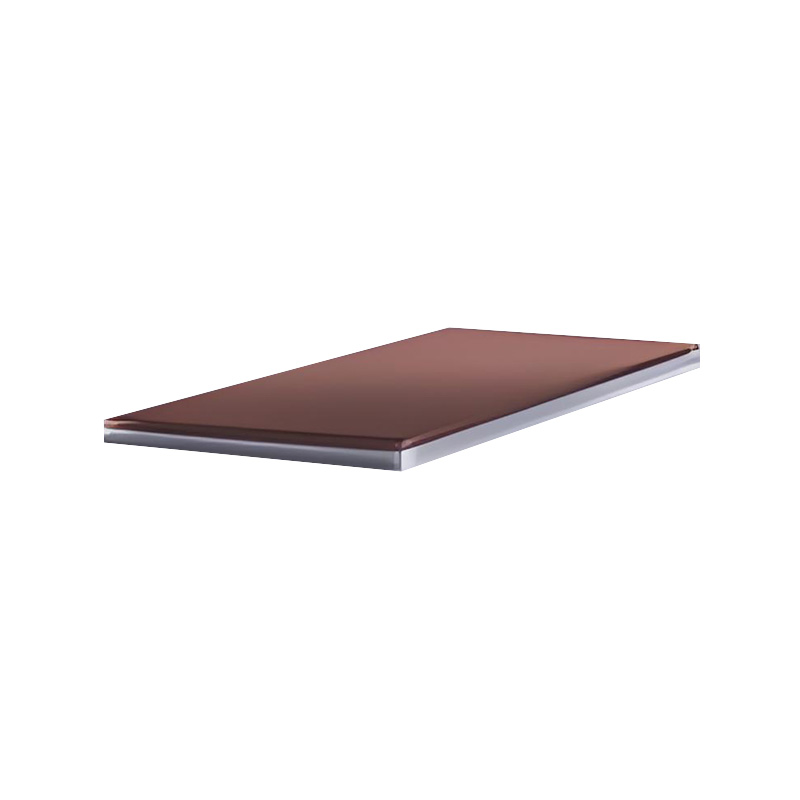 Single-Sided Copper-Aluminum Clad Material for Terminal TransitionsThis composite enables direct joining of copper cables to aluminum busbars without extra transition pieces, while its thermal properties help dissipate heat during high-rate charging.View Product →
In practice, the composite also helps manage heat. Copper disperses local hot spots while aluminum conducts heat away from the cell, reducing the temperature rise at the terminal during high-rate charging or discharging. This thermal behavior is especially important when the terminal is connected to a battery module that relies on liquid cooling or passive airflow. The same material logic is used in busbar designs, where current collection and heat dissipation are equally important.
When you evaluate a negative terminal material or a finished terminal component, focus on these five points:
 Cu-Al Composite Materials and Product Options for EngineersA range of copper-aluminum composites, including precision foils and double-sided clads, balances conductivity and weight. Useful for reducing field failure risks in EV battery connections.View Product →
Selecting a battery negative terminal is not just about choosing a metal. It is about balancing conductivity, weight, durability, and assembly cost over the life of the battery. Copper-aluminum composites give engineers an option that directly addresses the trade-off between copper’s performance and aluminum’s lightweight design. If your application involves EV battery packs or other high-current connections, evaluating the terminal material early in the design process reduces the risk of field failures and warranty issues.

 Applet
Call Center:
 Tel:+86-0512-63263955
 Email :[email protected]
Copyright © Goode EIS (Suzhou) Corp LTD
 Insulating Composite Materials and Parts for Clean Energy Industry


 cn
cn English